


Table of contents
No headings found in this article.
Hey guys my name is Jason Immekus. I want to take a few lines to introduce myself before we jump into todays topic. I have coached at the collegiate level for 18 years. I’ve worked in both the college recruiting and amateur scouting space and I am currently working here at Premier Pitching and Performance as a throwing trainer. Part of my job is to make sure the things we work on in the training environment translate into the season. Helping players understand the value of each phase of the throwing environments we put them in. These would be the initial assessment followed by offloading, mound building, pitch design, etc. While each phase is distinctly different, they all serve a specific purpose. The education of why we are doing each phase is often just as important as the physical work itself. That being said, the end goal is to make the player aware that all of these phases —performance work, mound blending, and pitch design —have the most important goal in common. Getting guys out in the game. Sure, the banger in late January is great, but can you execute it with the bases loaded and a full count on the opponent in July? You get my point. I will be writing future blogs on many topics, including how we can help players make the transition from training to wins!
Having a solid pre-game routine is where we will go today. By no means does a solid routine guarantee success, but not having some sort of routine will make it tough to maintain any sort of consistency, both mentally and physically, as we toe the rubber. In a game where failure is prevalent and sometimes out of our control, one thing we can control is our approach and preparation. A good pre-game routine can help ease anxiety and build trust in our processes and ourselves. This, in turn builds self-confidence, which is vital to pitching at a high level. Think of it this way, if you have a test in school on a subject that doesn’t come easy for you and you study a little each day leading up to the test, you will feel much more at ease and prepared for the task. If you don’t study, chances are you will be filled with anxiety and self doubt. This will often lead to poor scores, and only snow ball from there.
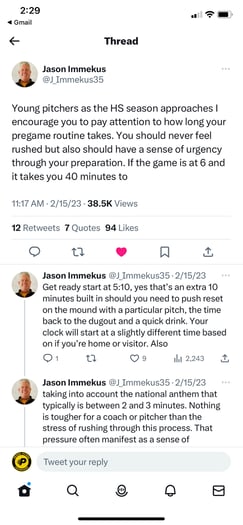
When beginning a pre game routine that works for you, you need to ask yourself a few questions. How much time does it take to get ready versus, realistically, how much time is available? What resources will I need: bands, plyos, etc? How much time do we need to rest before our first pitch? If it's colder or you’re getting off a long bus ride, I would suggest adding a few extra minutes to get loose. A little pre planning will go a long way in setting you up for success. Again, notice I said set up, not guarantee. I have enclosed a link to a thread I recently posted on Twitter, which provides more detail below.
CLICK HERE TO READ THE FULL THREAD
https://twitter.com/j_immekus35/status/1625907180699373568?s=46&t=6oPS7GVrEsb8GiYLP_M0qQ
Resilience is also an important aspect of our pre-game preparation. Just because we don’t have a great bullpen before taking the mound doesn’t mean that we will be bad in the game. The game is full of stories of guys who didn’t have a great pregame bullpen, maybe barely threw strikes, but went out and dominated in the game. The idea of the routine is to prepare our mind and body to compete. Just as the perfect band and plyo routine doesn’t ensure in-game success, it's important to understand a bad set isn’t the end of the world either. Yes, it’s great if it feels great, but our job is to go compete with the stuff we have on a given day, regardless of how it “feels”. You won’t always feel great, you won’t always have all of your pitches. The good ones find a way to make it work until they either find the feel for the pitch that eluded them pregame, or get enough outs to turn it over to the next guy with his team in position to win.
I hope you enjoyed reading this, and gained some insights on the value of a consistent routine. Feel free to reach out to me at jason@premierpitching.com if you have further questions about this topic or have a topic you would like to see me write about in the future! Until then, Go get some outs! I’ll be rootin’ for you!
- Jason Immekus


